
- News
- City News
- hubballi News
- Father-son duo in D’gere village increase income through apiculture
Trending
This story is from May 14, 2022
Father-son duo in D’gere village increase income through apiculture
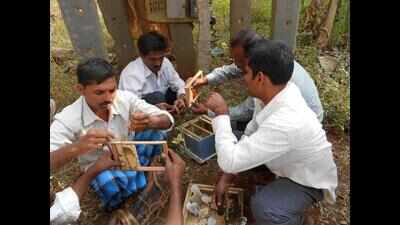
Parameshwarappa and his son Rudresh have been training fellow farmers in apiculture to help them augment their income

Highlighting the indispensability of bees to human existence, Parameshwarappa said that, in addition to the money he has earned through the sale of honey, apiculture has helped increase the fertility of the soil, which has, in turn increased the yield of mango, watermelon, banana and areca. “Apiculture in Karnataka is yet to grow as popular as it is in Kerala, which has bagged the first rank in production in honey,” Parameshwarappa said.
The father-son duo has been supplying 500 to 800 boxes of honey culture with bee colonies to the horticulture department for the past eight years. “We sell each box for Rs 4,500. We fabricate each box on our farm, which we supply to Bidar, VIjayapura, Bagalkot and Chitradurga,” Parameshwarappa added.
The father-son duo has organised several training programmes to help farmers from across the state augment their income through apiculture. These camps are held at the Taralabalu Krishi Vignana Kendra. “In addition to farmers, MSc students from Davanagere University approach us, and learn about apiculture on our farm,” the duo said.
Rudresh said that they could procure honey naturally for eight months of the year. “We cannot procure honey during the rainy season, but we feed them with a sugar solution to ensure the survival of the bees,” he said.
Rudresh said that they had managed to extract more than one tonne of honey in 2013. “I kept more than 100 honey boxes in Sirsi in Uttara Kannada district, and we have plans to collect honey by keeping more than 150 boxes in and around Jog Falls and Sagar in 2023,” he said.
Taralabalu Krishi Vignana Kendra horticulture officer Basavanagowda stressed the need to protect queen bees, since they were crucial for increasing crop yield through pollination.
End of Article
FOLLOW US ON SOCIAL MEDIA









Photostories

Hot Picks
TOP TRENDING
Popular Categories
Hot on the Web
Top Trends
Ratan Tata HospitalisedIND vs BAN Live ScoreIND vs SL Live ScoreNew UPI Transaction LimitHurricane MiltonWorld First Top 10 TrillionairesStock Market TodayKerala Lottery ResultElection Results 2024Tom BradyIsrael Hezbollah WarSuryakumar YadavManagement Colleges of IndiaTop Medical Colleges of IndiaTop Engineering Colleges of IndiaTop Pharmacy Colleges of IndiaLive Cricket Score
Trending Topics
Diwali WishesBigg Boss Tamil 8 Contestants ListBhool Bhulaiyaa 3 TrailerNavratri Colours 2024Sanjay Leela BhansaliDurga Puja 2024Bigg Boss 18 House PhotoDevara CollectionBigg Boss 18Deepika PadukoneShailesh LodhaDevaraColdplayNational Film Awards 2024Swatantrya Veer SavarkarColdplay India tour 2025Watch NFL Live StreamDress To ImpressCall Of Duty Black Ops 6Wordle Answer
Living and entertainment
Latest News
CATS YouTube codes for October 9, 2024: Earn 500 CATS and know how to redeem the codesHurricane Milton: Why Tampa area is so vulnerable to stormsBeard Trimmer with Titanium Blades: Style Your Beard to Perfection with Unmatched SharpnessTHE World University Rankings 2025: IISc Leads India , Check the List of Top 10 Indian Institutes HereAre HDFC Bank, Axis, Kotak a value buy or value trap for investors?Triptii Dimri on emotional struggles following criticism for 'Animal’: Side effect of being in a mainstream filmDid the threat of ‘first Hindu CM’ help NC-Congress win J&K?Ethel Kennedy, widow of Senator Robert F Kennedy Sr suffers stroke in sleep, hospitalisedRanbir Kapoor's UNSEEN BTS pic from 'Shamshera' goes viralSum 41’s Deryck Whibley accuses former manager of sexual abuse in new memoirMudassar Aziz: A filmmaker needs to carefully study while pegging a film around the idea of stardomHyundai aims to raise up to $3.3 billion in record India IPOPrabhas starrer 'Kalki 2898 AD' gears up for its release in JapanWho is Aniruddhacharya Maharaj? Know more about Pookie Baba’s life journey and net worthOnly a true creative genius can spot the odd unicorn in 12 seconds!Will Allu Arjun be able to beat Prabhas in North America with Pushpa 2?OnePlus 12 is available for Rs 35,314 only on Amazon; check exchange deal and bank offersIndian man goes ‘skinny-dipping’ at an Australia's beach that isn’t even on Google Maps | Watch video
Copyright © 2024 Bennett, Coleman & Co. Ltd. All rights reserved. For reprint rights: Times Syndication Service